Downhill Skate Race
- 4.5
- Rating
- 5.00M
- Installs
- Free
- Price

 Analysis by App-foxy
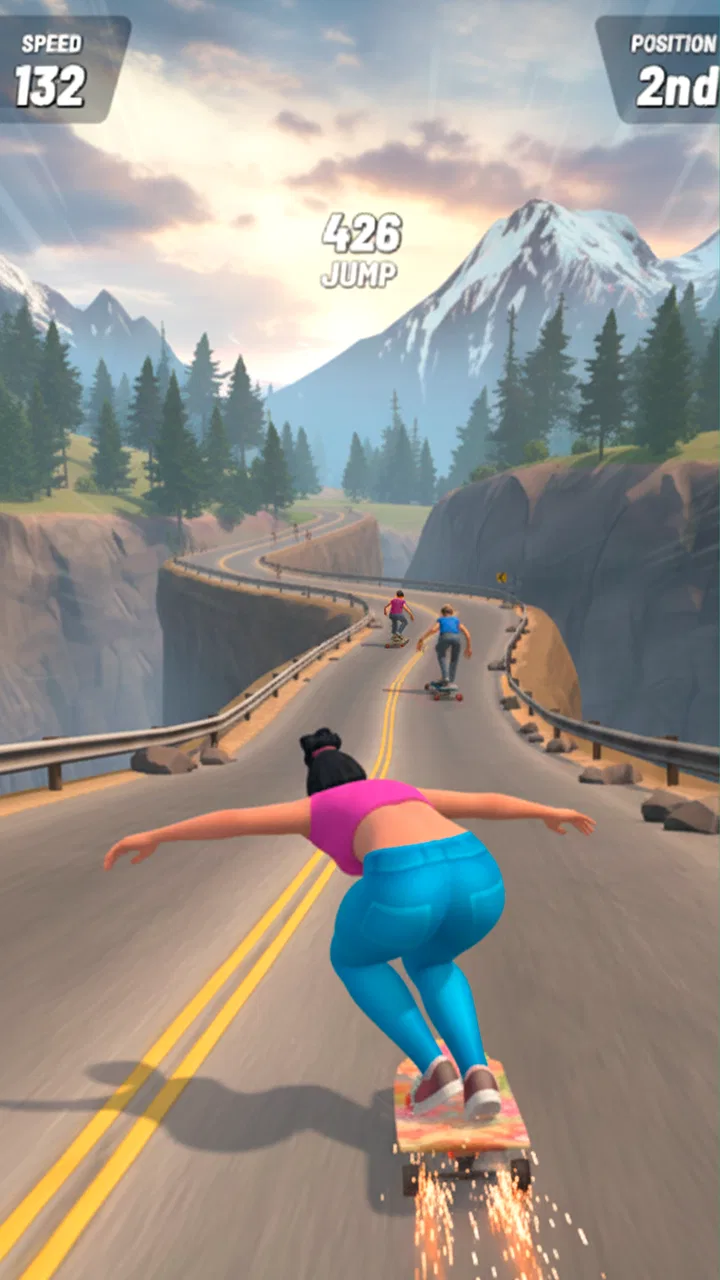
I approached Downhill Skate Race as the kind of quick arcade game you open when you want movement, timing, and a little pressure without committing to a long session. Its focus is straightforward: control a skateboarder during a downhill run, react to the route, and try to turn speed into a clean finish. After spending time with it, I found that its appeal depends less on a large feature list and more on whether you enjoy repeating short action challenges to improve your control.
The game is free, belongs to the arcade category, and comes from Freeplay Inc. It is available for players rated Everyone, which makes it an easy recommendation for families looking for something uncomplicated and accessible. It was released on Dec 25, 2024, and the current version is 1.6.2. The Android requirement is version 6.0 or later, so it should be suitable for many older devices as well as newer phones and tablets.
What matters most before installing it is understanding the type of experience this is. It is not a full skateboarding simulator with the depth of a console sports game, and I would not choose it if I wanted a huge career mode, detailed board customization, or a realistic recreation of street skating. Instead, it works as a compact downhill arcade challenge: easy to understand, quick to restart, and most enjoyable when you are trying to improve your own performance.
You May Also Like

 Blood Strike: 2.5 Anniversary
Blood Strike’s Loadouts Turn Every Drop Into a Tactical Gamble
A close look at Blood Strike’s custom loadouts: how fast access to signature weapons reshapes its battle royale rhythm, rewards preparation, and narrows the gap between fights.

 Pandora - Music & Podcasts
Pandora’s Music Is Easy to Start, but Harder to Recover
Pandora’s strength is its low-effort path from a seed to a station. Its weak spot is how much confidence it asks you to place in connection, setup, and quiet recovery.

 8 Ball Pool
 Is Built on Rivalries, Rematches, and Routine
A close look at the rivalries, rematches, shared routines, and unanswered safety questions that turn a quick pool match into a persistent mobile community.

 Samsung Music
’s Quiet Strength Is Playing What You Already Own
Its reach comes less from spectacle than from dependable access to a personal library. That simplicity is both the app’s strongest retention engine and its ceiling.

 AccuWeather: Weather Radar
AccuWeather Review: A Quick, Clear Forecast for Everyday Decisions
For everyday plans, the best forecast is the one you can understand quickly. AccuWeather makes rain timing, radar, and local conditions easy to act on, with a few trade-offs.

 Hill Climb Racing
Why Hill Climb Racing Still Turns Crashes Into One More Run
A tiny car, a bumpy hill and one more upgrade: Hill Climb Racing keeps resurfacing because its simple chaos makes every near-miss feel personal.
More From Our News Desk



How to decide whether the downhill format suits you
The first decision is about your preferred kind of arcade play. Some people want instant action with very little explanation, while others want a game that slowly unlocks systems, equipment, and long-term goals. Downhill Skate Race is better suited to the first group. Its premise can be understood immediately, and that makes it useful for short breaks, casual play, or handing a phone to someone who does not usually play games.
I also considered how much attention the game demands. Downhill movement naturally creates urgency: the route keeps coming, and hesitation can make a run feel messy. That makes each attempt more engaging than a completely relaxed endless game, but it also means the experience may not be ideal when you are distracted. I found it better for a focused few minutes than for playing while doing something else.
A useful test is to ask yourself what you want from a skateboarding game. If you want to practice timing, react to changing situations, and chase a cleaner run, this format makes sense. If you mainly want to design a character, explore a large environment, or perform complex tricks at your own pace, another type of skateboarding title will probably fit better.
The audience size suggests that the concept has broad appeal. The game has passed five million installs and holds a 4.5 average from around 48 thousand ratings. Those figures do not replace personal experience, but they do show that the simple downhill idea has connected with many players. I would still treat it as a casual arcade game rather than assume that its popularity means it offers the depth of a premium skateboarding simulation.
The control question matters more than the theme
For me, the most important part of a game like this is not the skateboard itself but the relationship between input and consequence. A good downhill arcade title should make mistakes understandable. When a run goes wrong, I want to feel that I reacted late, chose poorly, or failed to read the path—not that the outcome was random.
That is also the best way to judge your first sessions. Do not decide after a single attempt. Play enough to learn how quickly the action develops, then notice whether your second and third runs feel more deliberate. The strongest reason to keep playing is the sense that small improvements matter: a better reaction, a cleaner line, or a more confident decision can make the next attempt feel noticeably better.
One practical tip is to avoid treating every run as a race against maximum speed. In downhill games, rushing can make you react instead of anticipate. I had better results when I watched the route slightly ahead of the skateboard rather than focusing only on the character. That habit is useful for anyone who finds the opening attempts chaotic.
Why short sessions work well here
The game’s arcade identity makes it a natural fit for everyday moments. I can imagine playing it while waiting for a friend, taking a short break between tasks, or relaxing for a few minutes before bed. A run-based structure is also convenient because it does not demand that I remember a complicated story or return to a long mission after a pause.
A realistic use case is a commute with several brief interruptions. I would start a run, stop when I reached my destination, and return later without needing to reconstruct a plot or manage a large inventory. That convenience is a real strength, especially for players who prefer games that respect irregular schedules.
The trade-off is that short-session design can become repetitive if you do not enjoy self-improvement. Once the novelty of downhill skating wears off, your motivation depends on whether repeating attempts feels satisfying. Players who need frequent new objectives may find the loop less compelling than a progression-heavy alternative.
Where Downhill Skate Race wins
The clearest advantage is accessibility. The concept is easy to explain, the age rating is Everyone, and the game is free to download. That combination removes several barriers for a first-time player. I would feel comfortable suggesting it to someone who wants a simple arcade game but does not want to learn a complicated control scheme or commit money before deciding whether the style suits them.
The free price is particularly useful when choosing between categories. A paid skateboarding game may offer a more elaborate presentation or deeper systems, but it asks you to make that commitment immediately. Here, you can test the core downhill experience first. If the pace and repetition work for you, the installation has already answered the main question without requiring a purchase.
Another strength is the focused theme. The game does not need to explain a broad world before the action becomes meaningful. Downhill skating gives every moment a clear purpose: stay in control, read what is ahead, and complete the run. That focus helps the game feel approachable when I only have enough attention for one central task.
I also like the way this kind of design can encourage personal experimentation. Rather than relying entirely on a long list of unlocks, the player can improve through observation. Try a cautious approach, then a more aggressive one. Notice where you lose control. Change when you react instead of blaming the result on speed alone. These small tests are more useful than blindly repeating the same input.
Useful habits for getting more from each run
My first recommendation is to use early attempts as practice rather than judging them as failures. Learn the visual rhythm of the downhill route. Pay attention to how much time you have between noticing a problem and responding to it. This turns the game from a reflex test into a reading exercise, which is where its replay value becomes clearer.
Second, vary one decision at a time. If you change your timing, direction, and risk level all at once, you will not know what improved the result. Keep your approach mostly consistent, then adjust a single choice on the next run. That method is simple, but it makes arcade repetition feel purposeful instead of automatic.
Third, play with a stable grip and a clear view of the screen. This sounds obvious, but downhill games punish awkward phone placement more than slower puzzle games do. I found that holding the device where my hands were not covering important visual information made it easier to anticipate the next moment.
Finally, stop after a few frustrating attempts instead of forcing a long session. Because the game is built around quick action, fatigue can make your reactions worse and create the impression that the controls are less fair than they feel when you are focused. A short break often gives better results than continuing out of stubbornness.
What the current release means for a new player
The current version is 1.6.2, so anyone installing today receives a reasonably established version rather than an initial launch build. I would still approach updates practically: keep the game updated when possible, especially if you notice unusual behavior, because arcade titles depend heavily on responsive input and stable performance.
Its support for Android 6.0 or later is helpful for people using an older phone. However, an operating-system requirement is not the same as a guarantee that every device will feel identical. Screen size, touch response, and general device condition can affect a fast arcade game. If your phone already struggles with other games, I would keep expectations moderate and test it during a short session before making it a regular time-filler.
The game’s popularity also makes it easier to recommend as a known casual option rather than an obscure experiment. It has around 150 written reviews alongside its broader rating activity, giving prospective players some extra community context. I would not use that alone to decide, but combined with the free entry point and simple premise, it makes trying the game a low-risk choice.
Where another type of game may fit better
Downhill Skate Race is not the right choice for everyone. If your ideal skateboarding experience is about expressive trick combinations, you may prefer a trick-focused game where landing and chaining moves are the main attraction. A downhill arcade format prioritizes forward momentum and immediate decisions, so it may feel narrow if you want to spend time practicing individual stunts.
It may also disappoint players who want a long-term management layer. Some alternatives in the wider sports and racing space emphasize equipment choices, character development, leagues, or a detailed campaign. Those games can provide stronger reasons to return over weeks, while this title is more dependent on the pleasure of replaying runs and sharpening your reactions.
There is a similar distinction between arcade racing and simulation. A simulation player may care about realistic physics, authentic board behavior, and a large set of technical controls. I would not select this game for that purpose. Its value is in immediacy, not in reproducing every part of real skateboarding.
Players who dislike repetition should think carefully before installing. The free price makes experimentation easy, but it does not change the basic loop. If you need a constant stream of new environments or objectives to stay interested, a larger adventure or progression game may be a better use of your storage and attention.
On the other hand, people who often abandon complex games because there are too many menus may prefer this one. The focused format avoids the mental overhead that comes with managing several systems. That is an important comparison: a deeper alternative may offer more content, but Downhill Skate Race can be more enjoyable when the real goal is simply to play immediately.
The main friction points to consider
The same simplicity that makes the game approachable can limit its staying power. I enjoyed the clarity of the downhill objective, but I would not describe it as a substitute for a full skateboarding game. Its strongest moments come from an individual run and the desire to improve the next one, not from a broad world that continually reveals new layers.
Fast arcade action can also be less comfortable for players who prefer a calm pace. If you want to pause frequently, study a route for a long time, or make decisions without pressure, the downhill format may feel demanding. This is not necessarily a flaw, but it is a clear mismatch for some playing styles.
Another consideration is the difference between casual access and lasting motivation. Free installation is convenient, yet the real question is whether you personally enjoy the repeat-and-improve structure. I would give it a fair trial, then decide based on whether I was learning from each attempt or merely restarting out of habit.
For parents, the Everyone rating makes the game easier to consider for a broad household audience. I would still encourage adults to play it first if they want to judge the pace and suitability for a particular child. Age labels communicate the intended audience, but personal sensitivity to fast action and frustration varies.
The cost of switching from your usual arcade game
Switching to this game is inexpensive in financial terms because it is free. The more meaningful cost is attention. If you already have an arcade title that gives you a satisfying daily challenge, adding another quick game may not improve your routine. I would install this one when I specifically want downhill movement and reaction-based play, not simply because it is available.
The storage and learning costs should also be considered in practical terms. The Android requirement is modest, but the experience still depends on whether your phone handles touch input comfortably. Give yourself a few attempts to understand the pace before deciding that the game belongs in your regular rotation.
There is also a habit cost. A short arcade game can be easy to open repeatedly because each attempt feels unfinished. I recommend setting a simple stopping point, such as ending after a successful run or after a fixed number of tries. That keeps the game useful as a break instead of allowing a brief session to expand without purpose.
For someone moving from a slower puzzle game, the adjustment is mainly about anticipation. For someone moving from a racing game, the change is likely to be the skateboard-focused presentation and the narrower objective. For someone leaving a deep sports simulation, the biggest adjustment will be accepting that the game values immediacy over realism.
That comparison helps clarify the best role for it. I would not replace every other arcade game with Downhill Skate Race. I would keep it as a lightweight option for moments when I want a direct challenge that starts quickly and does not require a long commitment.
My recommendation after playing it
I recommend Downhill Skate Race to players who enjoy short, repeatable arcade sessions and like the feeling of improving through timing. It is especially suitable for casual players, families seeking an Everyone-rated game, and anyone who wants to try a skateboarding-themed title without paying upfront. The combination of a clear premise, free access, and a large existing player base makes it easy to try.
I would be more cautious about recommending it to players who expect a complete skateboarding simulation, a deep career, or endless customization. Those expectations point toward a different category of alternative. This game is at its best when you judge it as a focused downhill challenge rather than as a comprehensive sports package.
Before deciding, I would use a simple three-step test. Play several runs without rushing, change one part of your approach, and then ask whether the improvement feels rewarding. If the answer is yes, the game has probably found its audience in you. If every restart feels like the same task and you are waiting for a larger progression system, it is better to move on to a more substantial alternative.
My final view is positive but specific: this is a convenient arcade game, not an all-purpose skateboarding experience. Freeplay Inc has chosen a narrow idea and made it approachable enough for quick play. The result is worth installing when you want downhill action, simple entry, and room to refine your reactions. The best reason to keep it is the satisfaction of making one cleaner run than the last.
FAQs for Downhill Skate Race
01What is Downhill Skate Race and how does it work?
Downhill Skate Race is an exhilarating mobile game where players navigate through challenging downhill courses on a skateboard. The game features intuitive touch controls, allowing players to tilt their device to steer and tap to perform tricks. With a variety of levels and obstacles, it tests both skill and strategy.
02What devices support Downhill Skate Race?
Downhill Skate Race is available on both Android and iOS platforms. It is optimized for most smartphones and tablets. Ensure your device meets the minimum OS requirements: Android 5.0 or higher, and iOS 10.0 or later. This ensures smooth gameplay and access to all features.
03Are there any in-app purchases or ads in Downhill Skate Race?
Yes, Downhill Skate Race includes in-app purchases for items like new skateboards, customization options, and additional levels. The game also features ads, which can be removed through a one-time purchase. These purchases help support the developers and enhance your gaming experience.
04Can I play Downhill Skate Race offline?
Downhill Skate Race offers the ability to play offline, allowing you to enjoy the game without an internet connection. However, some features like leaderboards and accessing new content may require a connection. It's perfect for gaming on the go, but reconnect when you can to update.
05Is Downhill Skate Race suitable for all ages?
Downhill Skate Race is rated for players aged 9 and up. It contains mild animated violence typical of sports games, making it suitable for most age groups. Parents can rest assured that the game is designed to be family-friendly, with no explicit content or language.
Pros
- Smooth graphics enhance gameplay experience.
- Intuitive controls for quick learning.
- Variety of tracks keeps it engaging.
- Multiplayer mode for competitive fun.
- Regular updates with new features.
Cons
- In-app purchases can be expensive.
- Limited character customization options.
- Occasional lag on older devices.
- Ads can be frequent and disruptive.
- Requires constant internet connection.

Downhill Skate Race
Gallery